
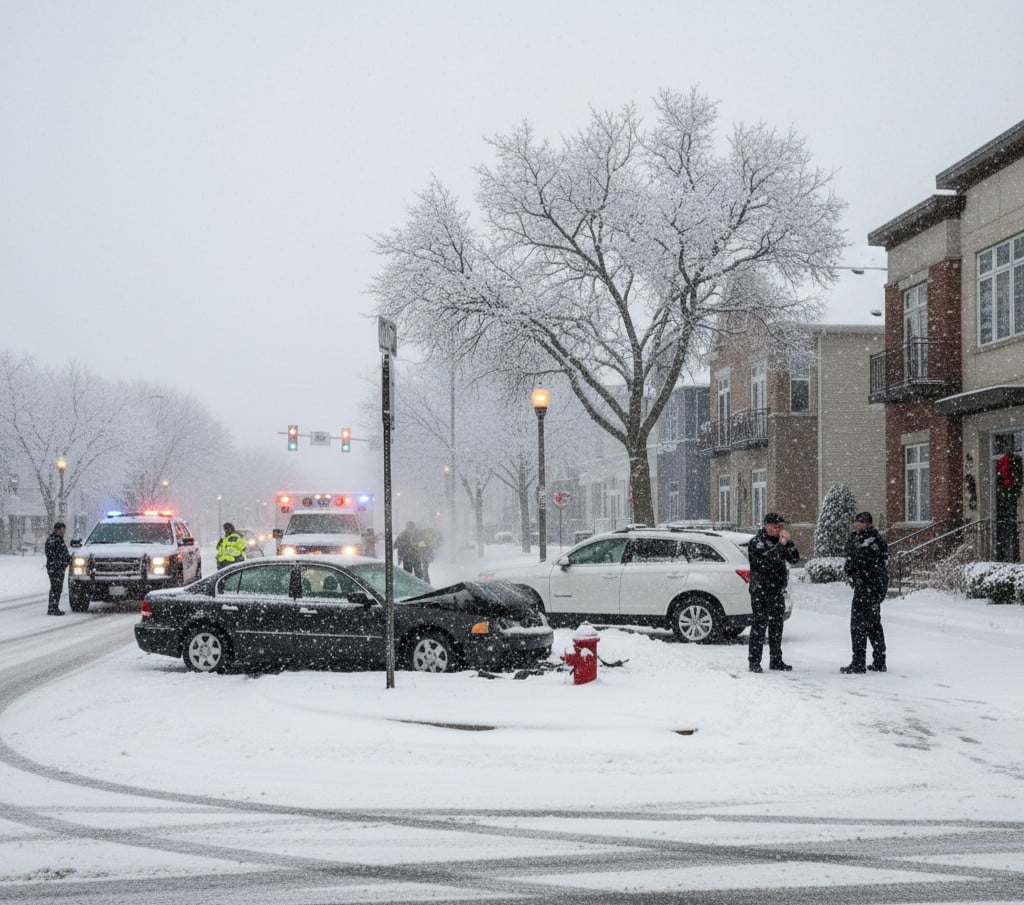
Snow, ice, sleet, rain, fog…Illinois has it all. Think weather is to blame? Think again!
Simply put, weather is never a legitimate excuse for a collision. Weather conditions alone do not cause car accidents – careless drivers do. In Illinois, a driver has a duty to exercise “ordinary care” in the operation of their vehicle. Ordinary care means the care a reasonably careful person would use under the circumstances. The circumstances to be considered include the weather, road conditions, traffic, and visibility when figuring out who is to blame for a weather-related car accident. Driving 65 miles per hour on I-88 might be “reasonably careful” on a clear, sunny day with dry roads, but driving 65 miles per hour on that same highway during a snowstorm with icy roads would be negligent. A reasonably careful person would slow down and leave extra room between their vehicle and the one in front of it because slick roads increase the distance required to stop; the failure to act as a reasonably careful person would under the circumstances is the definition of negligence. (Illinois Pattern Jury Instruction 10.02)
Oftentimes, people involved in car accidents believe that the “weather is to blame” because the other driver wasn’t issued a ticket, but who is at fault for a collision is not up to a police officer. Whether or not the police officer decides to write a traffic ticket for a collision is up to his or her discretion; in weather-related crashes, it is common to see officers give a break to the vehicle who caused it. A traffic ticket is not conclusive evidence of guilt – conversely, the lack of a traffic citation is not evidence of innocence in causing a collision. In Illinois, if someone pleads guilty to a traffic violation, and the conduct giving rise to that violation is a cause of the collision, the guilty plea can be used to help establish negligence, but an officer’s failure to issue a ticket cannot be used as a defense.
When someone is rear-ended by another vehicle, it is almost always the rear vehicle’s fault. There are a few rare exceptions to that rule-of-thumb, like if someone stops suddenly for no reason and they are rear-ended, where someone “brake checks” the car behind them in a road-rage situation, but for the run-of-the-mill rear-ender, it is the rear car’s fault. The rear car is to blame because the law requires drivers to leave enough distance between their vehicle and the one in front of them so they can stop safely without causing a collision. It is common for a desperate defendant to claim, “the car in front of me stopped suddenly, and there wasn’t enough time for me to stop,” but ultimately, if there isn’t enough time to stop when the car in front stops suddenly, that means the rear car is following too close for conditions, and they are at fault, not the icy roads and not the driver in front of them.
Intersection related crashes can be a little more complicated, but it remains true that weather is a circumstance, and a defendant doesn’t get a free pass by blaming the weather. Typically, a vehicle turning left will be at fault if they turn into oncoming traffic because the turning vehicle has a duty to yield to oncoming traffic and only enter the intersection when it is safe to do so; the oncoming traffic has the right-of-way. If icy roads cause a vehicle that is trying to stop to skid into oncoming traffic…you guessed it! They were going too fast for conditions, and they are at fault, not the weather.
Car and truck accidents can happen for many reasons, and while the weather may play a role in the circumstances, the weather is not at fault. When the roads are slick, a driver must reduce their speed enough to remain in control of their vehicle. Except on rare occasions, car accidents are not intentional. The defense loves the idea of reminding a jury that accidents happen. However, car accidents occur because of bad choices – driving too fast, following too closely, using a cell phone while driving. These bad decisions can cost an innocent victim their health, or even their life. So, while it isn’t intentional (in which case it would be a criminal case), it is only fair to hold people accountable for the consequences of their bad choices.
Every winter in Illinois, it seems like drivers have forgotten how to drive safely in snowy/icy weather and people are injured because they don’t take the extra care required to keep them and everyone around them safe. If you or a loved one has been in a car or truck accident, contact us for a free, no-pressure, consultation. Even if we aren’t retained to represent you, we are happy to spend some time understanding your situation and will give you legal advice at no cost.

Injured? Get a free case evaluation.
Our attorneys are available 24/7 to discuss your situation.